

07: An Old Hollywood Score
One of the things we we did on Resonance in the project’s spirit of testing things out we’d never done before, was not only a creative choice - an ‘old Hollywood’ style orchestral score - but also recording the score with live musicians. For me as a director, hearing Ken’s score (which by this stage I knew pretty intimately) performed by people in a room with real instruments was an unexpectedly moving experience. I was truly blindsided by it!
Here’s a bit of a Q&A chat with the man himself, and his approach to the music.
You can listen to his amazing score for the film on Spotify now.
- Enzo.
A conversation with composer Kenneth Lampl
Q: What was the original musical brief for Resonance?
Rather than having detailed discussions about the music, Enzo put a lot of classical music into the temp score as a way for me to understand the emotion of each scene. He used music from Holst’s The Planets, Barber’s Adagio for Strings and Mozart’s Requiem.
This was our first feature film together, and I remember Enzo saying that he came to me specifically because I was one of the few composers he knew who had the classical and orchestral background to compose a score like this. I went to the Juilliard School and wrote a lot of contemporary classical music before my introduction to film music, so this was a musical world I felt very comfortable in.
Q: What did the classical temp music tell you about the film?
What the temp tracks communicated to me was that the science-fiction aspect of the film was really the context for a much deeper emotional story dealing with memory, regret and redemption.
As our protagonist, Clara, discovers the artifacts belonging to her grandmother, she is also reliving her relationship with her daughter, Eliza, and confronting the choices she made as both a mother and a scientist. That became much more important to me musically than simply scoring the science-fiction elements of the story.
Q: How did you approach themes in the score?
There are a number of themes that recur throughout the score, but they aren’t necessarily associated with specific characters. They are more connected to relationships and psychological states.
There is a theme associated with Clara and her daughter Eliza, and other themes connected to the processes of mystery, discovery and ultimately redemption.
I’m more interested in scoring the emotional process we are seeing rather than simply attaching a theme to a character. In that way, the score maps the emotional journey of the film, and as that journey progresses, the themes transform and adapt with it.
Q: Why an orchestral score for a science-fiction film?
Enzo was very clear from the beginning that he wanted an orchestral score, and I was really excited about that because I rarely get the opportunity these days to compose a fully orchestral film score.
One of the things a purely orchestral score does is mirror Clara’s search back through time into an earlier period and culture. But it also allows us to keep the focus on the emotion and drama of the film rather than emphasising its science-fiction elements.
In a way, the orchestra connects those two worlds: the story is dealing with very contemporary ideas about quantum physics and dimensional rifts, while Clara is reaching backwards into the past. The music can do the same thing.
Q: What were the main musical influences?
My main inspiration was Neptune from Holst’s The Planets, which for Enzo really captured the essence of the film. That piece has a certain harmonic uncertainty and melancholy that informed much of the score.
It also became a bridge for me to the music of Bernard Herrmann, who readers may know from his scores for Alfred Hitchcock films such as Vertigo, Psycho and North by Northwest. I’m a huge Herrmann fan, and his approach to film scoring was instrumental in the way I approached Resonance.
I would also say you can hear elements of James Newton Howard’s score for The Sixth Sense and Alexandre Desplat’s music for Harry Potter and the Deathly Hallows. Both of those scores capture something of that same atmosphere I hear in Holst and Herrmann, but through a more contemporary film-music language.
Q: What did you take from Bernard Herrmann?
Herrmann was a master of scoring the inner psychology of his characters. That has always been a major influence on me.
For me, influence is often about much more than particular compositional devices. It’s an approach to scoring. Herrmann understood that music could reveal what was happening inside a character rather than simply describing what was happening on screen.
That was particularly important in Resonance because I wanted the music to take us inside Clara’s emotional journey rather than simply tell us that something mysterious or scientific was happening.
Q: What role did samples play before recording the orchestra?
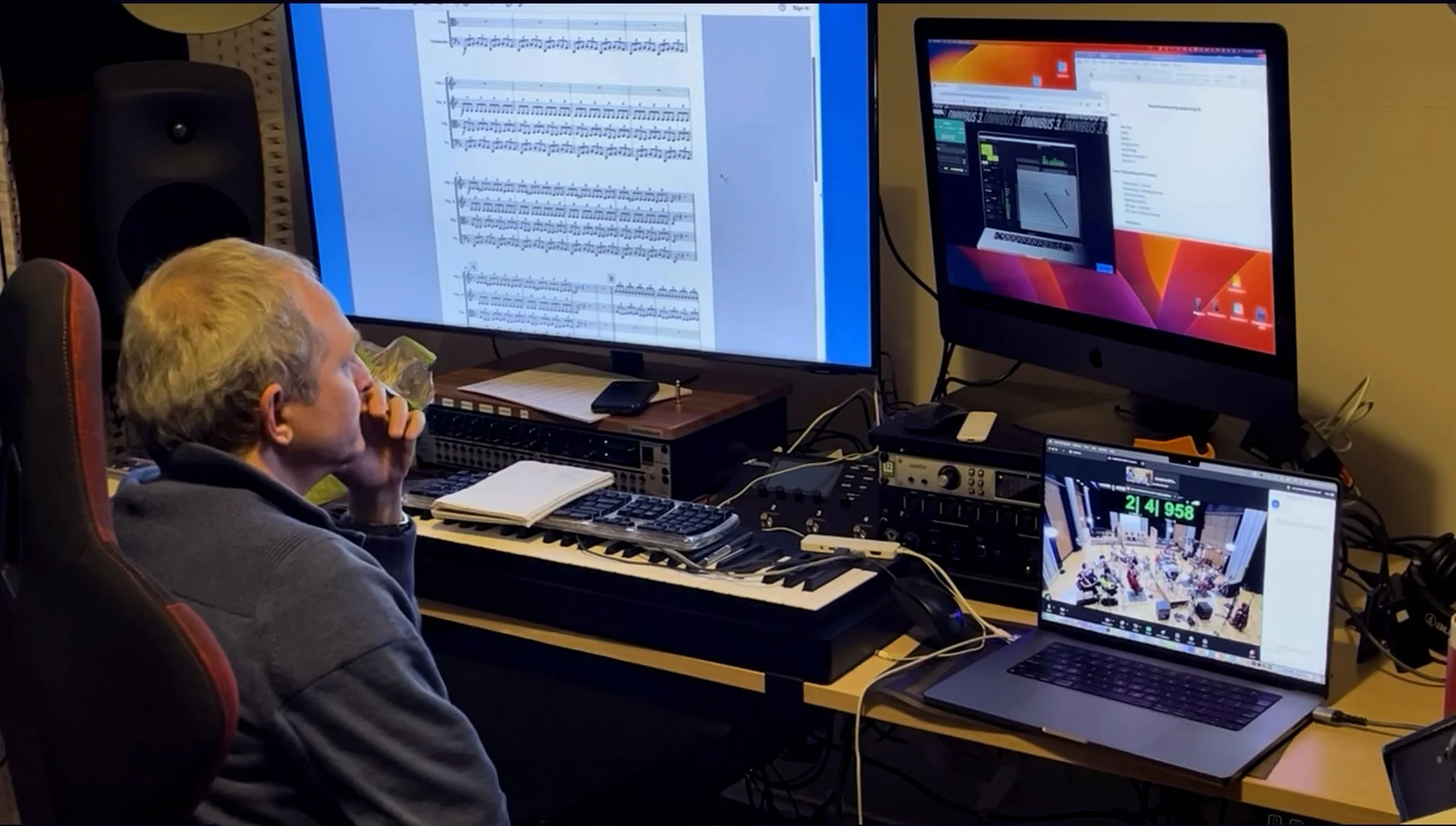
Sample libraries are a great tool for collaboration. I can create a draft of a cue using orchestral samples, Enzo can hear it and give me feedback, and then I can revise it. The samples give him a very good idea of how the music will eventually sound before anything has actually been recorded.
That allows us to iron out all the details before the recording session. By the time Enzo and Barbara came over for the session, they already knew all of the music in great detail before the orchestra had played a single note.
Q: What do live musicians bring that samples cannot?
Live musicians bring the score to life in a way that a sample library simply cannot. A sample library is ultimately designed to approximate what live instruments sound like. It is an incredibly useful compositional and collaborative tool, but it isn’t the final performance.
Once real musicians begin playing the music, you have all the subtlety, expression and interaction that comes from human performance. For a film that is ultimately so much about memory, relationships and human emotion, I think that was especially important.
There’s also something I really like about the contrast. Resonance deals with futuristic ideas and uses very contemporary filmmaking technology, yet at the centre of the score you have this very traditional process: musicians sitting together in a room and performing music. For me, that combination of old and new fits the film perfectly.